Bosporus by Ferry, the Long Tour, the Commuter Boats and What You See From the Water
The best way to understand the Bosporus is to get on the water with the people who live along it. Istanbul's ferries carry commuters between Europe and Asia all day, for the price of a bus ticket, and from their decks you see the whole story this site covers: tankers queuing for the strait, the palaces of a bankrupt empire, the bridge renamed after a failed coup, and the fortress built to strangle Constantinople.
The ferries are run mostly by Şehir Hatları, the city lines company owned by the Istanbul Metropolitan Municipality. Since March 2025 the municipality's elected mayor, Ekrem İmamoğlu, has been in prison awaiting the outcome of a mass corruption trial (the İmamoğlu case), and the city council has run Istanbul through an acting mayor. The boats still leave on time.
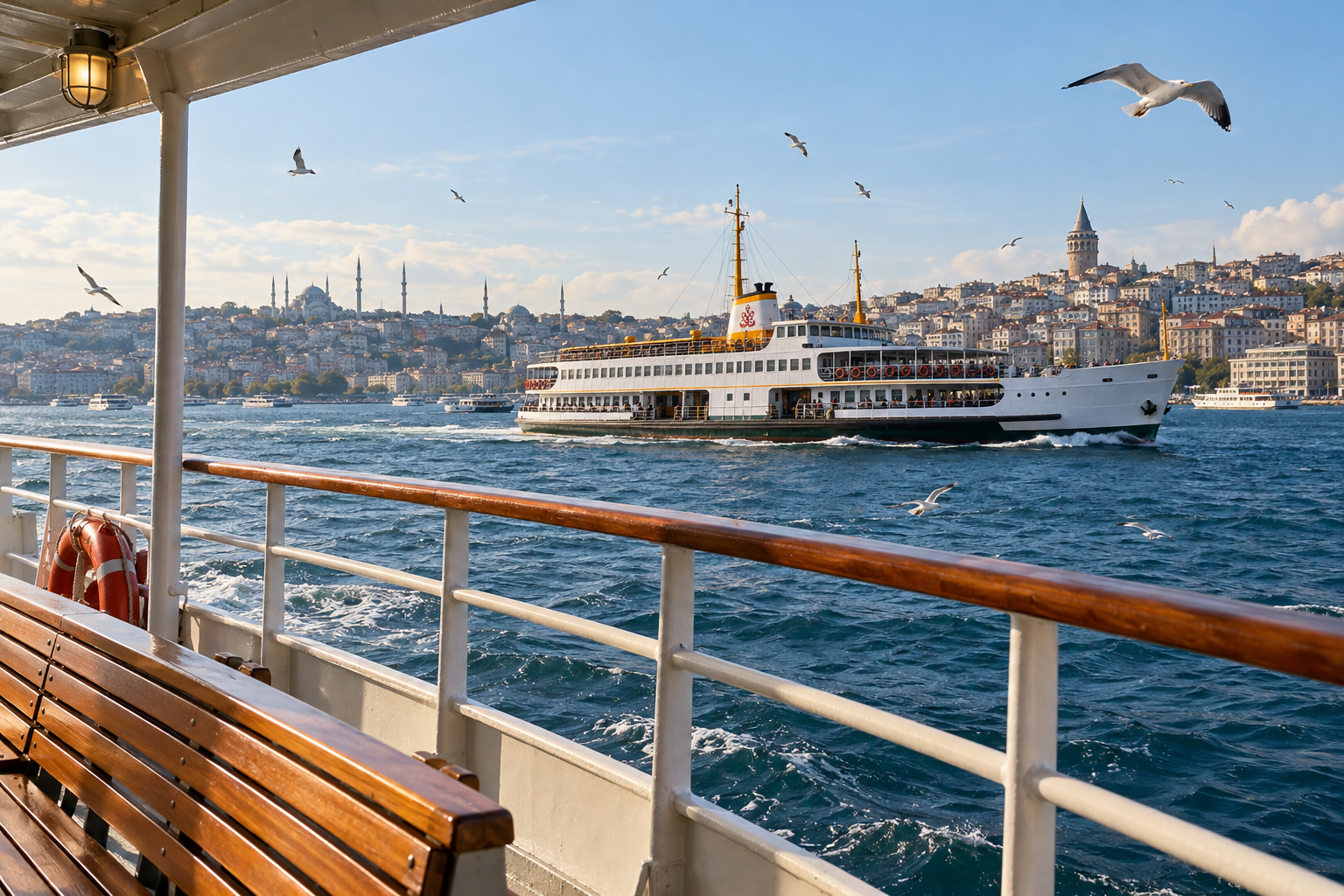
Image: pxef.com
The long Bosporus tour
The classic trip is the Uzun Boğaz Turu, the long Bosporus tour, from the dedicated tour pier at Eminönü near the Galata Bridge. It zigzags north between the two shores, calling at Beşiktaş, Üsküdar, Kanlıca, Sarıyer and Rumeli Kavağı, and ends at Anadolu Kavağı, almost at the Black Sea. The whole day takes about six hours, including a stop of around three hours at Anadolu Kavağı, enough to climb to the ruins of Yoros Castle and eat fish on the quay. Departures are in the morning, with extra sailings in summer; timetables change by season, so check on the day.
Sit on the left side going north for the European shore: Dolmabahçe, Ortaköy and the first bridge, Bebek, and the towers of Rumeli Hisarı under the second bridge. Coming back, the same side gives you the Asian shore: Kanlıca, Anadolu Hisarı, Kandilli, Beylerbeyi Palace and Üsküdar. From Anadolu Kavağı you look straight out to sea, where the merchant ships wait at anchor for their turn to enter (traffic and transit rules).
There's also a short tour of about two hours that runs from Eminönü to İstinye and back without stopping long anywhere, and in summer an evening "moonlight" cruise.
The commuter way
You can see most of the same things for less on the ordinary commuter lines, using an Istanbulkart, the city's transport card. Eminönü to Üsküdar, Üsküdar to Beşiktaş and Beşiktaş to Kadıköy cost about 45 to 60 lira a leg on an Istanbulkart in 2026. The routes cross the southern end of the strait rather than going up it, but they pass Maiden's Tower, Topkapı and Dolmabahçe at close range and give you the view of Hagia Sophia's minarets that sailors have had for five centuries.
Private operators also run tour boats from Eminönü, Kabataş and Beşiktaş, from short hop-on loops to dinner cruises. They're more flexible and usually more expensive; agree the route and price before you board.
What to watch for
The strait is a working waterway first. You'll see tankers and bulk carriers, some of them old, some carrying Russian oil (the shadow fleet), passing a few dozen metres from your ferry. Notice how the ships slow and swing at the bends around Kandilli and Yeniköy, where the current runs fastest (the strait in numbers). On a busy day you might see a Turkish navy ship, but not a NATO carrier: the Montreux Convention keeps those out.
Then the bridges. The first (bridges and tunnels) carries the name 15 July Martyrs; the third, near the Black Sea, carries the name of a sultan many Alevis remember for massacres.
A tea from the ferry's buffet, a simit for the gulls, and you have the strait's whole history on one ticket.