Haydarpaşa and Sirkeci, the Two Stations at the Mouth of the Bosporus and the Fight Over What They Become
Two railway stations face each other across the southern mouth of the Bosporus. On the European side, under the walls of Topkapı, is Sirkeci, the old terminus of the Orient Express. On the Asian side, on the Kadıköy waterfront, stands Haydarpaşa, the stone castle of a station built as the start of the line to Baghdad and Mecca. For a century travellers changed continents between them by ferry.
Neither has sent off a mainline train since 2013. In June 2026 the scaffolding came down from Haydarpaşa's sea front for the first time in about fifteen years, and the government says both stations will reopen as culture centres. What else they will become is the argument.
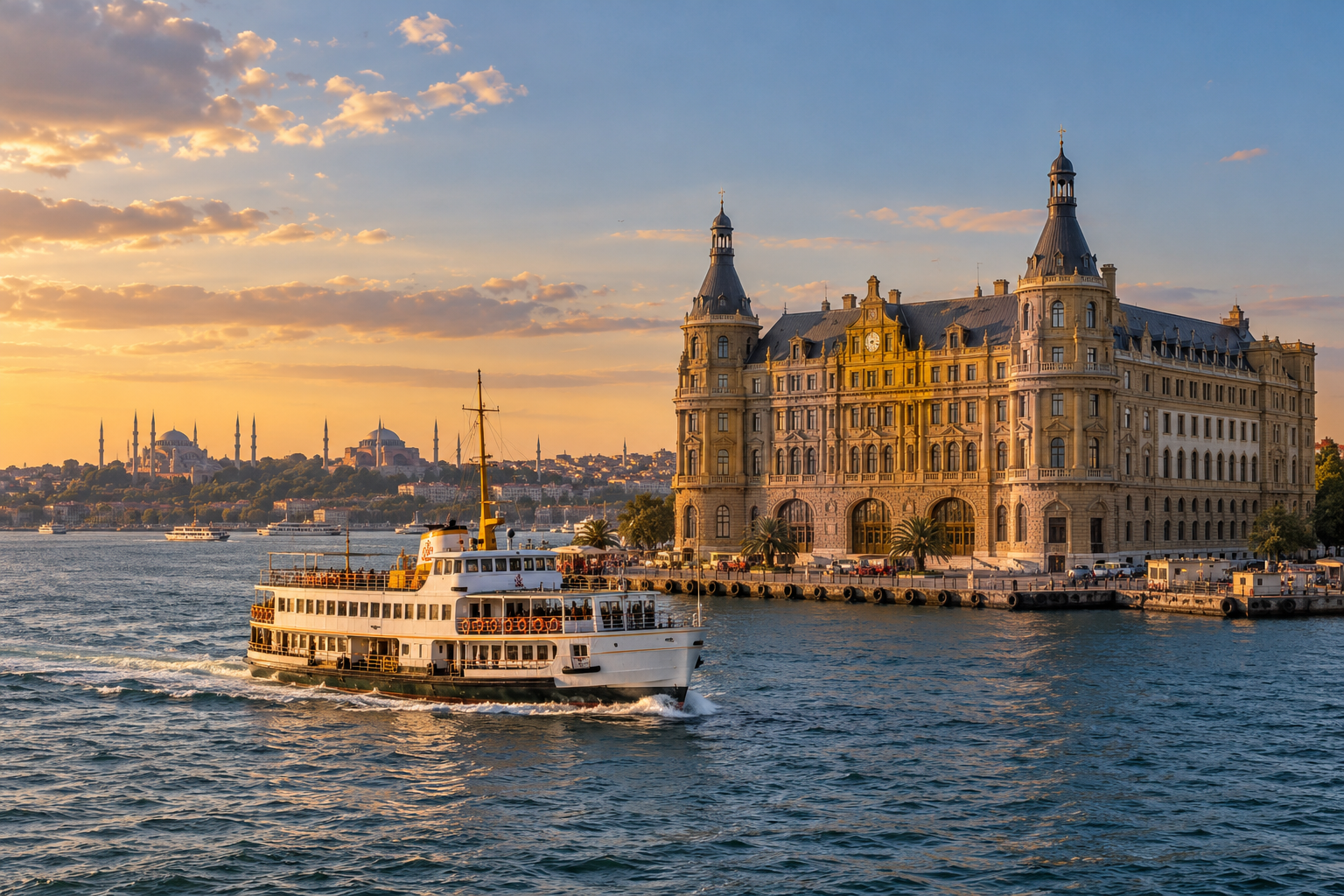
Image: pxef.com
Sirkeci, the end of Europe
Sirkeci opened in 1890 as the terminus of the line from Vienna and Paris, and the Orient Express made it famous. For millions of Turks it is remembered for the trains that went the other way: from the 1960s the guest workers recruited by West Germany left from Sirkeci for Munich. German President Frank-Walter Steinmeier went there in April 2024 to mark that history, and Ankara plans a migration museum in the station's buildings.
The tracks still run underground. Since 2013 the Marmaray rail tunnel has carried commuter trains under the strait, with a deep station at Sirkeci (bridges and tunnels). The old terminus above it has stood mostly idle.
Haydarpaşa, the start of Asia
Sultan Abdülhamid II ordered Haydarpaşa built as the gateway of his railway into Anatolia and on towards Baghdad and the Hejaz. German architects, Otto Ritter and Helmuth Cuno, designed it, and it opened in 1908, standing on wooden piles driven into the sand of the shore. The Kaiser's Germany financed the line; the station is the most visible monument of that alliance.
It has been unlucky. An ammunition explosion wrecked it in September 1917. In November 1979 the Romanian tanker Independența collided with another ship off the station and exploded, shattering its windows (shipping accidents). In November 2010 a fire destroyed much of the roof. Trains stopped in 2013 for the Marmaray works, and the excavations that followed found remains going back to the fifth century BC.
A prize site
Haydarpaşa and the port next to it occupy some of the most valuable land in Istanbul, and for twenty years governments have looked at it as real estate. Plans in the 2000s included skyscrapers, a trade centre and hotels; none went ahead after public protest. A group of railway workers, architects and residents, the Haydarpaşa Platform, has held a vigil outside the station every Sunday for years, demanding that it stay a station.
In 2024 the Ministry of Culture and Tourism took the station over from the railways and told railway families living in the complex to leave. Its plan includes a performing arts centre, a library, museums, an archaeology park for the excavation finds, and a public garden. In October 2024 Culture Minister Nuri Ersoy promised that both stations would keep a rail function and would "never" become a shopping mall or a hotel, and set October 2026 as the target to hand them back to the public.
Why people don't believe it
The promise is now due. The protesters' distrust is not about architecture. Under Recep Tayyip Erdoğan, Istanbul has watched the Gezi Park plan in 2013, the third Bosporus bridge, and Canal Istanbul driven through from Ankara with little say for the city, while its elected mayor, Ekrem İmamoğlu, sits in prison (his arrest). A culture centre run by a ministry, with no trains, is not what the Sunday vigil has been asking for.
The restored façade is handsome. Whether a train ever leaves Haydarpaşa again will say more about who runs Istanbul than any museum inside it.