Bosporus Shipping Accidents, From the 1960 World Harmony Fire to the Ship That Hit a Yalı
On 7 April 2018 a Maltese-flagged bulk carrier, the Vitaspirit, lost steering while heading south through the Bosporus and drove straight into the Hekimbaşı Salih Efendi yalı at Kandilli, a waterfront mansion about two centuries old. Video of a bulk carrier crushing a historic waterfront house went round the world. Nobody was killed. But it showed, in one image, what Istanbul lives with every day: tens of thousands of ships a year passing a few hundred metres from people's homes, in a strait with fast currents and sharp bends (the strait in numbers).
The Bosporus has a long accident record. Most of its rules exist because of it.
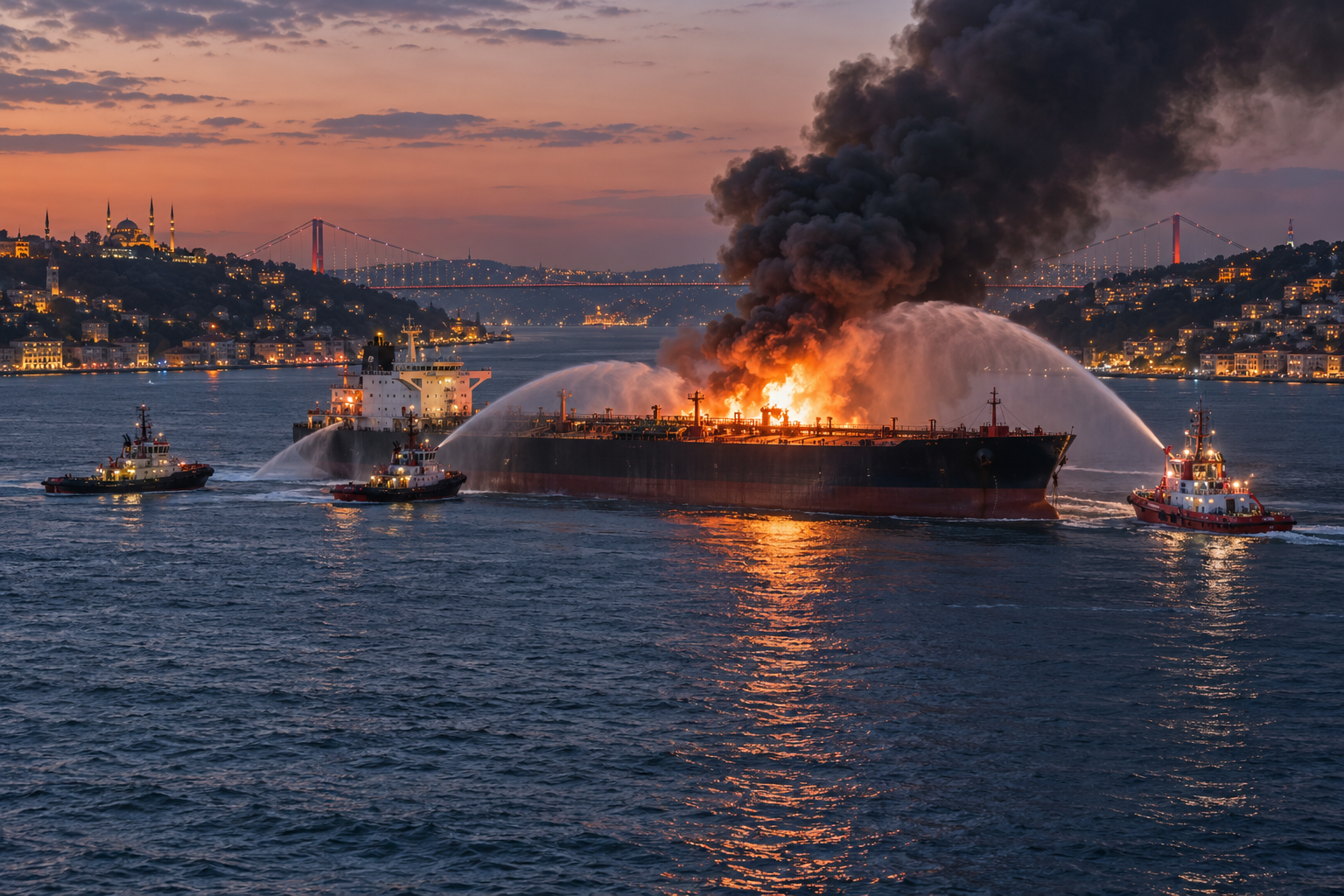
Image: pxef.com
The great fires
The worst disasters were oil fires. On 14 December 1960 the Yugoslav tanker Petar Zoranić and the Greek tanker World Harmony collided off Kanlıca. Both burned, and a Turkish ship, the Tarsus, caught fire alongside them. Twenty officers and crew died, including both masters, about 18,000 tonnes of oil spilled, and the fire burned for weeks, closing the strait.
On 1 March 1966 two Soviet tankers, the Lutsk and the Krasny Oktyabr, collided near Maiden's Tower. Burning oil spread across the water and set fire to a city ferry and the Karaköy ferry terminal, which burned to the ground.
On 15 November 1979 came the worst of all. The Romanian tanker Independenta, loaded with crude, collided with the Greek freighter Evriali off Haydarpaşa, at the strait's southern mouth, and exploded. The tanker burned for weeks. Forty-two of its crew died, and about 94,600 tonnes of crude was lost, burned or spilled, one of the largest tanker disasters in the world at the time.
On 13 March 1994 the Cypriot tanker Nassia collided with the bulk carrier Shipbroker at the northern end. About 20,000 tonnes of oil burned over four days, another 9,000 spilled, traffic stopped for days, and 27 people died.
Collisions, groundings and sheep
Not every accident involved oil. In 1966 two collisions involving city ferries killed 21 people between them. In 1990 the Iraqi tanker Jampur, carrying gasoline, collided with a Chinese bulk carrier off Sarıyer and spilled 2,600 tonnes. In November 1991 the Lebanese livestock ship Rabunion XVIII sank off Anadolu Hisarı after a collision; five people and about 21,000 sheep drowned, and the carcasses badly polluted the water.
Groundings have been just as common. In 1999 the Russian tanker Volgoneft-248 broke in two off Florya, spilling 1,500 tonnes onto the beaches. In 2002 the Gotia ran aground at Bebek and smashed into the marina. In 2003 a Georgian cargo ship broke in two off Anadolu Feneri. In October 2013 the chemical tanker YM Miranda caught fire and, dragging its anchors, cut an undersea fibre-optic cable near Anadolu Hisarı.
How the rules came out of the wrecks
Four months after the Nassia, Turkey introduced its first comprehensive traffic regulations in July 1994: separate northbound and southbound lanes, limits on large ships carrying dangerous cargo, and rules for fog and strong currents. A radar vessel traffic service followed in December 2003. Since then, more ships take Turkish pilots and tugs: escort tugs accompanied 10,543 ships in 2024 against 1,422 in 2017, and maritime accidents in the straits fell 21 percent in 2025 compared with 2024 (traffic and transit rules).
The danger has changed shape rather than gone away. Ships are fewer and bigger, so a single accident carries more. Many tankers in the Russian trade are old, with thin insurance (the shadow fleet), and the Black Sea beyond the strait is a war zone (Black Sea war and shipping).
Every captain who sails past Kandilli knows the Vitaspirit video. That may be the most useful safety rule of all.