Rumeli Hisarı and Anadolu Hisarı, the Twin Fortresses That Closed the Bosporus Before 1453
The Bosporus is at its narrowest, about 700 metres, between Aşiyan on the European shore and Kandilli on the Asian one. Two Ottoman fortresses face each other across it there. Together they show, in stone, why whoever holds this stretch of water holds the Black Sea.
The smaller and older is Anadolu Hisarı, on the Asian side where the Göksu stream meets the strait. Sultan Bayezid I built it in the 1390s, during an earlier Ottoman attempt on Constantinople, as a compact keep with a curtain wall. It gave the Ottomans a foothold on the water, but on its own it couldn't stop ships.
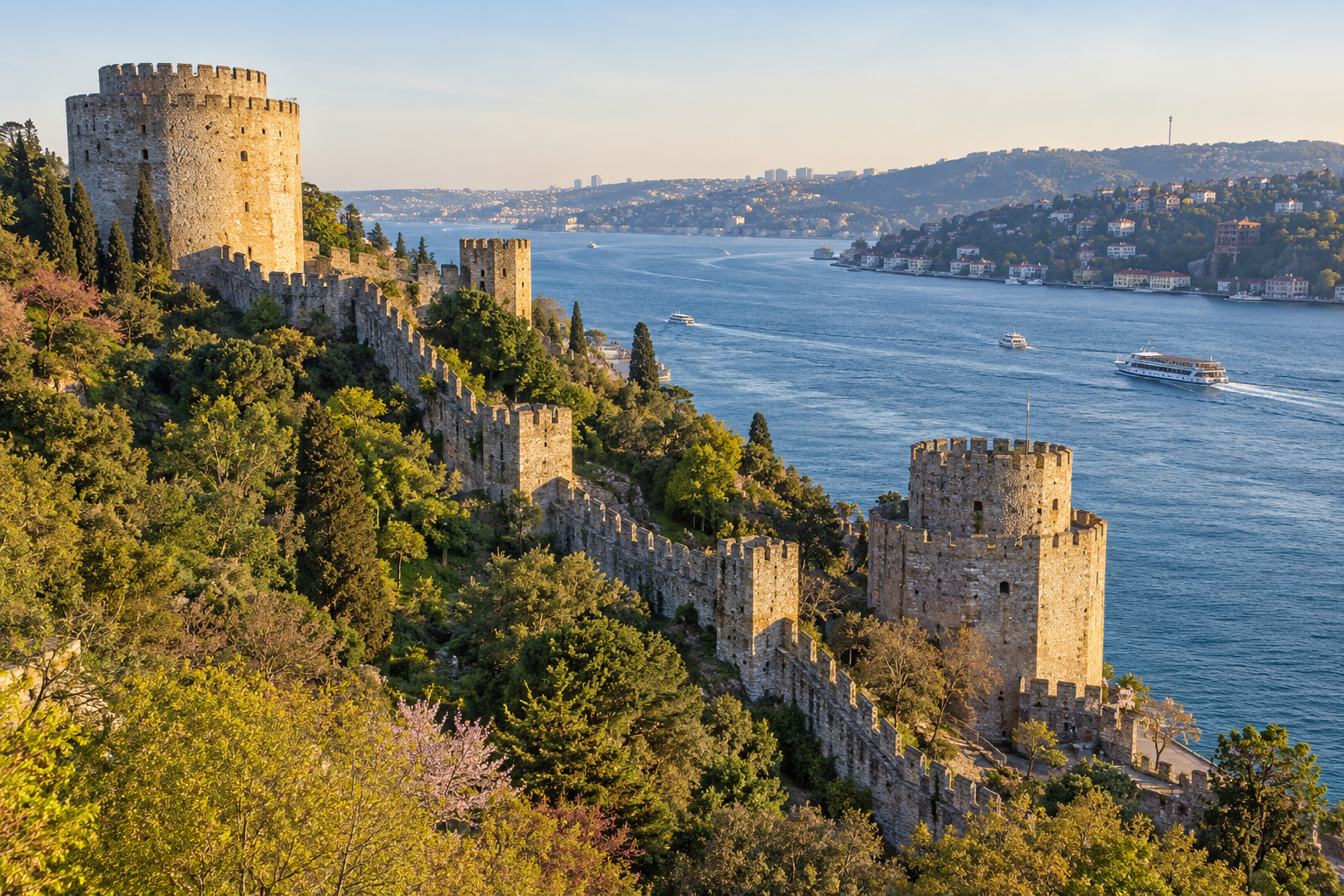
Image: pxef.com
The throat-cutter
In the spring of 1452 the young Mehmed II, not yet 21, ordered a fortress built on the European shore directly opposite. His builders finished it in about four months, between April and August. The Ottomans called it Boğazkesen, which means both "strait-cutter" and "throat-cutter". Its three great towers and the curtain walls climbing the hillside between them were built for one purpose: to put cannon on both sides of the narrowest point of the Bosporus and close it to anything bound for Constantinople from the Black Sea, including the grain the city lived on.
Mehmed meant it. Ships were ordered to stop and pay. In November 1452 a Venetian ship that refused was sunk by the fortress guns; its captain was executed and his body put on display. From then on the Byzantine capital was cut off from its northern supply route. On 29 May 1453 the city fell.
The fortress is the clearest lesson the Bosporus has to give in military geography. The Montreux Convention still turns on the same fact: a few hundred metres of water can be closed from the shore, and whoever can close it can bargain with everyone who needs it open.
Five centuries on
Once the city was Ottoman, the fortresses lost their purpose. Rumeli Hisarı became a prison and a customs post, and later a neighbourhood grew up inside its walls. The Republic cleared and restored it in the 1950s and opened it as a museum, and its amphitheatre-like slopes became one of Istanbul's best-loved open-air concert venues in summer.
Then it closed. As of autumn 2026, Rumeli Hisarı has been under restoration by the Istanbul Metropolitan Municipality for about six years, with no announced reopening date. The site is behind hoardings, its car park taken over by the contractor, and businesses on the waterfront road say the closure has cost them; one restaurant owner says he has had to cut his staff by half. Anadolu Hisarı, across the water, is the subject of a separate municipal restoration and museum project; check whether it is open before you go. For now you see both best from the water, on a ferry up the strait (the ferry guide), or from the cafés and fish restaurants along the shore road at Rumeli Hisarı and at Kandilli.
The university above the walls
On the hill behind Rumeli Hisarı stands Boğaziçi University, the descendant of Robert College, founded by Americans in 1863 and for decades Turkey's most open and internationally minded university. In January 2021 Erdoğan appointed a party loyalist, Melih Bulu, as its rector by presidential decree, bypassing the faculty. Students and professors protested for months. Police raided the campus, hundreds were detained, and Erdoğan asked in public whether the protesters were students or terrorists. Bulu was removed in July 2021, and Erdoğan appointed another outsider in his place.
The episode fits the place. A fortress built to choke the strait, and above it a university the state decided to bring to heel. Both are about control.
The towers are still the first thing you notice from the water. Mehmed would be pleased.